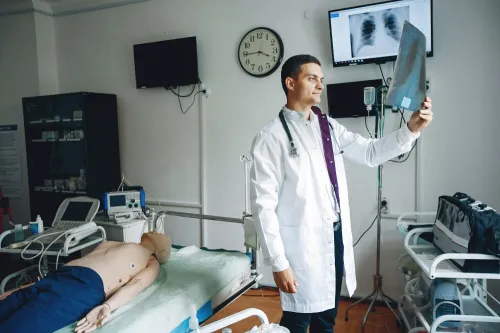
Students choosing imaging training need more than a course label: they need repeated practice, supervised clinical exposure and proof that a provider teaches safe equipment use. By comparing DRIT with narrower options and checking clinical access, recognition and admission terms, you can judge whether a Pune course prepares you for junior imaging work or only supplies classroom knowledge.
Key takeaways
- Choose DRIT for broader imaging preparation and supervised department practice.
- Confirm students practise positioning, radiation safety, equipment checks, and patient communication.
- Ask how often students train in functioning imaging departments before admission.
- Compare DRIT with an X-ray certificate against your target job role.
What DRIT students practise before entering an imaging department
Before seeking entry-level imaging work, a DRIT student should perform core tasks under supervision, not merely describe them in an examination. The value of DRIT practical training in Pune depends on repeated practice in real departments, with a supervisor checking each step.
1. Verify the patient’s name, age, examination request, pregnancy status where relevant, and the correct body part before entering the room.
2. Prepare the X-ray room, detector, accessories and prescribed exposure settings; position the patient accurately, provide radiation protection, and prevent avoidable repeat exposures.
3. Follow the assigned protocol for general radiography and observe how CT, MRI, ultrasound, mammography or other services differ. Do not assume a course covers every modality; confirm which departments provide supervised access.
4. Review basic image quality for positioning, coverage, motion and exposure, then send or record the examination through the department’s workflow without altering findings or giving a diagnosis.
5. Assist with patient transfers, infection-control procedures, privacy and clear instructions for breath-holding or remaining still. Practise calm communication with children, older adults, trauma patients and people in pain.
A trainee should also understand contrast-study preparation, venous-access assistance and emergency reporting, but must follow the supervising clinician’s protocol rather than independently prescribe contrast or manage a severe reaction. MRI practice must include implant and metal screening, controlled-zone behaviour, hearing protection and projectile prevention.
Ask for signed competency records, supervised clinical hours and exposure to quality-assurance and radiation-monitoring procedures; a certificate alone does not prove hands-on readiness.
How classroom learning becomes safe, supervised imaging work
Anatomy becomes safe positioning: you identify the body part, protect the painful area, align the patient and select a view that answers the referral question. Radiation physics then explains why distance, collimation, exposure factors, shielding and controlled access matter; ignoring them can produce unnecessary dose or a nondiagnostic image.
DRIT lessons translate into supervised department work through practice in:
- Patient care: transfer children, older adults and trauma patients safely, protect privacy, follow hand hygiene, communicate before movement and recognise deterioration.
- X-ray and CT: prepare the room, confirm identity and examination, position the patient, assist with contrast studies, acquire images under instruction and perform basic quality checks.
- Records and teamwork: document the examination, note difficulties or reactions, communicate clearly with the radiologist and never present technical training as authority to interpret or diagnose images.
Radiation-protection training should reflect AERB requirements, including shielding, controlled access, equipment approval, personnel monitoring, quality assurance and safe operating procedures. A good image is not a safe image if the patient is misidentified or an avoidable repeat is needed.
MRI requires a separate safety mindset: screen for implants and metal, control access to restricted zones, use hearing protection and understand projectile, burn and emergency risks. Ultrasound, mammography and interventional imaging also require modality-specific instruction.
Confirm which areas the course actually covers; DRIT training benefits for imaging jobs in Pune depend on supervised competency, not the abbreviation alone.
Why Pune clinical exposure affects how soon you become useful
Supervised clinical training in Pune helps you become useful sooner when it mirrors the pace, records and patient needs of working hospitals and diagnostic centres. You should handle patient identity and referral checks, explain procedures clearly, position patients, follow prescribed protocols, acquire images under supervision and complete examination records without delaying the next appointment.
A strong placement includes:
1. Rotation through genuinely busy imaging departments, not only a short observation visit. Confirm whether training covers general radiography and which of CT, MRI, ultrasound or mammography are actually available.
2. Practice with RIS and PACS, appointment scheduling, digital image handling, report communication and documentation. These transferable skills help you move between diagnostic centres and hospital departments, subject to each employer’s requirements.
3. Exposure to infection control, teamwork, quality assurance, radiation monitoring and controlled-area procedures. Radiology technician preparation in Pune must include AERB-aligned safety practices such as shielding, controlled access, personnel monitoring and approved equipment—not just pressing console buttons.
Contrast-study assistance must follow the facility’s protocol and the supervising clinician’s scope. A trainee should not independently prescribe contrast, obtain venous access, diagnose images or manage severe reactions without authorised supervision.
Ask before admission how many supervised clinical hours are guaranteed, who signs competency records and whether students participate in repeat-exposure review and quality checks. A certificate or brief visit cannot prove hands-on competence; documented practice across real patient workflows can.
DRIT or an X-ray certificate: which route fits your target role?
Choose the route by the first role you want. An X-ray certificate suits a learner targeting supervised general-radiography work; DRIT suits someone seeking wider imaging-department exposure; BSc Radiography fits a longer academic and progression path.
| Route | Breadth and workload | Practical exposure and progression |
|---|---|---|
| X-ray certificate | Concentrates on X-ray-room preparation, positioning, exposure and basic image checks. The narrower syllabus can mean less classroom and placement time. | Useful for junior X-ray duties where the employer accepts the certificate; confirm whether CT, MRI and RIS/PACS practice are included. |
| DRIT | A diploma-level course combines anatomy, radiation physics, patient care and imaging principles. The broader workload covers workflow across selected modalities. | Look for supervised radiography plus verified CT or MRI exposure, documentation and patient handling. Progression depends on the awarding body, logbook and employer. |
| BSc Radiography | A degree requires greater academic depth, assessment and time. It can support broader progression, subject to recognition and recruitment rules. | Clinical rotations may be more structured, but coverage still depends on the university and affiliated hospitals. |
| Other allied-health courses | Laboratory technology, operation theatre technology and physiotherapy prepare you for different equipment, risks and patient tasks. They are not substitutes for imaging training. | Choose them for those departments, not as a shortcut into radiography. |
The practical drit course career benefits in pune come from transferable skills: RIS/PACS use, scheduling, infection control, records and teamwork. Before enrolling, check the prospectus for named modalities, placement hours and CT dose training covering CTDIvol and DLP; “imaging exposure” alone proves little.
What to verify before DRIT admission in Pune
Before paying for a DRIT admission in Pune, verify the eligibility rule, awarding body, clinical placement and fee conditions in writing. Providers can set different requirements, including SSC, Higher Secondary with science subjects, age limits, entrance tests, medical fitness and internship completion.
Check these points with the admissions office:
- Ask which marksheet qualifies: SSC, HSC, or an equivalent science qualification.
- Request the complete document list, including identity proof, photographs, migration or transfer certificate, and medical certificate if required.
- Ask how many supervised clinical hours are guaranteed, not merely described as “exposure”.
- Confirm whether training includes general radiography, CT, MRI, ultrasound, mammography or only selected modalities.
- Ask who signs competency records and whether students rotate through busy hospital departments.
- Ask whether students observe radiation monitoring, quality assurance, infection control, RIS/PACS use and image documentation.
- Request the fee schedule, refund policy, internship terms and a receipt before payment.
| Check | What to confirm | Warning sign |
|---|---|---|
| Eligibility | Minimum qualification, subjects, age and selection test | Staff give different answers |
| Recognition | Awarding body, affiliation and sample certificate | Only “government approved” is stated |
| Clinical training | Hours, departments, equipment and logbook signatory | A short visit is called hands-on training |
| Documents and fees | Prospectus, receipt, refund and internship conditions | Payment is requested without written terms |
Ask K. P. Paramedical Institute to identify the awarding body and show where each promise appears in its prospectus. The DRIT course career benefits in Pune depend on verifiable practical records, not the abbreviation alone.
Related product
 | Best DRIT The Diploma in Radiology & Imaging Technology (DRIT) at K P Paramedical Institute is a career-oriented paramedical program designed to prepare... View product → |
Frequently asked questions
What do DRIT students practise before entering an imaging department?
They practise patient positioning, equipment checks, radiation safety, image handling, documentation, and clear patient instructions under supervision.
How does classroom learning become safe, supervised imaging work?
Students apply anatomy, physiology, imaging principles, and radiation protection during demonstrations and supervised practice before performing tasks independently.
Why does Pune clinical exposure affect how soon a DRIT graduate becomes useful?
Regular exposure to functioning departments builds familiarity with patient flow, referrals, equipment routines, infection control, and communication with clinical staff.
Should you choose DRIT or an X-ray certificate?
Choose DRIT when you want broader imaging preparation and a wider clinical foundation; choose an X-ray certificate when its narrower scope matches your target role.
What should you verify before DRIT admission in Pune?
Verify the syllabus, practical hours, department access, supervisor qualifications, equipment used, assessment method, internship terms, and documents required for admission.